Wednesday, 30 July 2014

Aaron - First High Priest of Israel

 
Aaron was the firstborn son of Amram and his wife/aunt Jochebed, who were Levites (Exodus 2:1; 6:20). He was born during Israel's time in Egypt, 83 years before the Exodus, 3 years before his brother Moses, and about 10 years after his sister Miriam (Exodus 2:1,4; 6:20; 7:7).

Aaron married Elisheba, a daughter of Amminadab, who was of the tribe of Judah (Exodus 6:23; 1 Chronicles 2:10). They had 4 sons - Nadab, Abihu, Eleazar, and Ithamar.

When the time of the Exodus came, God sent Aaron (Exodus 4:14, 27-30) out to meet the returning Moses (who had just spent 40 years out in the Sinai with Jethro), to join with him in their assigned task. Aaron was to be the spokesman for Moses, who was unable to speak well, perhaps from stuttering (Exodus 6:30; 7:1-2,9-10,19). Although Moses was the leader, it was Aaron who did the actual speaking to Pharaoh through the events leading to the Exodus, and the crossing of the Red Sea.

Aaron stepped up as a strengthening partner throughout the ordeal, then later led the people in formalized worship of God in the wilderness.


Aaron was a faultless servant with his brother, at least at first. At Rephidim, when Moses overlooked the battle with the Amalekites from a nearby hill with the rod of God in his outstretched hand, it was Aaron and Hur (his brother-in-law, Miriam's husband), who held up Moses' tired arms until Israel's forces under Joshua won the battle (Exodus 17:8-13).

Aaron's greatest lapse in judgment occurred while Moses was away on the mountain receiving the Ten Commandments from God. For whatever reason, Aaron gave in to the people's demands, and made that now-infamous golden calf for the people to worship (Exodus 32:4). When Moses returned, Aaron was sternly rebuked, but was forgiven by God after Moses prayed for him. Aaron came very close to being killed for that incident (Deuteronomy 9:20)
Aaron was appointed directly by God to be the first high priest. He and his sons were consecrated to continue the priesthood through time (Leviticus 8 and 9).

Aaron again displayed a failure in good judgment at Hazeroth when he and Miriam spoke out against Moses for marrying a Cushite (Ethiopian) woman. Once again, The Lord vindicated Moses, and punished Miriam, who had led the minor rebellion, with leprosy (Numbers 12:1-16). After Aaron acknowledged his and Miriam's error, at the intercession of Moses they were forgiven by God.

Aaron's career seemed to blow hot and cold. He certainly had his low points (i.e. the golden calf), but overall he remained a steadfast ally of his brother. During the Korah rebellion, Aaron stood courageously with Moses (Numbers 16:1-50). Not long after that, the miraculous sprouting of his staff was used to demonstrate that he was indeed the high priest to those who were questioning his authority (Numbers 17:1-13). That staff was afterwards preserved in the Tabernacle (Hebrews 9:4)

Neither Moses nor Aaron were permitted to enter the Promised Land (See Heartbreak Mountain). Aaron was involved in the water-from-the-rock incident at Meribah (Numbers 20:8-13), and for that presumptuous disobedience to God's instructions both were not permitted to enter the Promised Land (Numbers 20:24).

Aaron died at Mount Hor after his priestly authority was transferred to his son Eleazar. He was 123 years old (Numbers 20:23-29, Deuteronomy 10:6, 32:50). The people mourned his passing for 30 days
 
Accomplishments of Aaron:
Aaron began Israel's first formal line of priests, was first to wear the priestly garments and started the sacrificial system. He helped Moses defeat Pharaoh. With Hur, he supported Moses' arms at Rephidim so the Israelites could defeat the Amalekites. When Israel had finished its wandering, Aaron went up Mount Sinai with Moses and 70 elders to worship God.

Aaron was loyal to Moses, an eloquent interpreter, and a conscientious priest.

Aaron's Weaknesses:

When Moses did not come down from Mount Sinai, Aaron helped the Israelites craft a golden calf and worshiped it with them. Aaron did not set a good example for his sons and did not instruct them in absolute obedience to the Lord, resulting in his sons Nadab and Abihu offering "unauthorized fire" before God, who struck both men dead.

Aaron joined Miriam in criticizing Moses' marriage to a Cushite woman. Aaron also shared in Moses' disobedience to God at Meribah, when the people demanded water, and thus was forbidden to enter the promised land.

Life Lessons:

We all have strengths and weaknesses, but the wise person asks God to reveal both. We tend to be proud of our strengths while ignoring our weaknesses. That gets us into trouble, as it did Aaron.

Whether we are operating in one of our talents or struggling under our shortcomings, we do well to keep our focus on God for guidance. Aaron's life shows us we don't have to be the leader to play an important role.

Wednesday, 30 April 2014

Adam


Adam was the first man on earth, and for a short time he lived alone. He arrived on the planet with no childhood, no parents, no family and no friends. Perhaps Adam's loneliness moved God to quickly present him with a companion, Eve. Before God created Eve, he had given Adam the Garden of Eden. It was his to enjoy, but he also had the full responsibility of taking care of it. Adam knew that one tree was off-limits, the tree of the knowledge of good and evil.

Adam would have taught Eve the rules of the garden. Even though she knew it was forbidden to eat the fruit from the tree in the middle of the garden, when Satan tempted her, Eve was deceived. When she offered the fruit to Adam, the fate of the world was on his shoulders. As they ate the fruit in that one act of rebellion, man's independence and disobedience separated him from God.

But God already had a plan in place to deal with man's sin. The Bible is the story of God's plan for man. Adam is "our" beginning, and we are all his descendants.

According to the Bible, Adam was the first human being on Earth and the father of all humanity. In the book of Genesis (1:26), Adam is created by God on the sixth day of creation, in God's own image, and given dominion over all the animals of the world. God then gives Adam a female partner, Eve. Eve feeds Adam fruit from the forbidden Tree of Knowledge, after which an angry God expels them from the Garden of Eden. In Christian theology, Adam's failure to obey God is known as the Original Sin. Adam fathered three sons by Eve: Cain, Abel and Seth.

Adam's Accomplishments:
God chose Adam to name the animals, making him the first zoologist. He was also the first landscaper and horticulturist, responsible to work the garden and care for the plants. He was the first man, the father of humankind. He was the only man without a mother and a father.

Adam's Strengths:
Adam was made in the image of God and shared a close relationship with his Creator.

Adam's Weaknesses:

We see that Adam avoided his God-given responsibility. He blamed Eve and made excuses for himself when he committed a sin. He hid from God in shame, rather than facing his error and admitting the truth.

Life Lessons:

We see from Adam's life that God wants us to freely choose to follow and obey him out of love. We also learn that nothing we do is hidden from God. Likewise, it does not benefit us to blame others for our own failings. We must accept personal responsibility.

Sunday, 2 February 2014

The meaning of the names of the 12 Tribes

  1. Judah -           "I will praise The Lord "
  2. Ruben -           "He has looked on me "
  3. Gad-                "Given good fortune"
  4. Asher-            " Happy am I "
  5. Naphtali-        "My wrestling"
  6. Manasseh-     "Making me to forget"
  7. Simeon -       "God Hears me"
  8. Levi-            " Joined to me"
  9. Issachar-      "Purchased Me"
  10. Zebulun-      "Dwelling"
  11. Joseph-        "Will add to me"
  12. Benjamin-    "Son of his Right Hand"

Saturday, 6 April 2013

Jacob

 
Jacob was one of the great patriarchs of the Old Testament, but at times he was also a schemer, liar, and manipulator .Jacob is a troubling character in the Old Testament. He is conniving and he is spiritual too. He has moments of strong faith as well as of fear. His family is sometimes in disarray, and yet at the end he is the one who sets it straight. Jacob, whose very name suggests "deceiver," is renamed by God as "Israel" -- "one who has struggled with God." And an entire nation is named after this patriarch -- the nation of Israel.

Jacob is a bit too much like us -- with very human strengths and weaknesses, but a man with a striving for spiritual things. From this imperfect man we learn important lessons of faith. Especially, we learn about God's grace

God established his covenant with Jacob's grandfather, Abraham. The blessings continued through Jacob's father, Isaac, then to Jacob and his descendants. Jacob's sons became leaders of the 12 tribes of Israel.

The younger of twins, Jacob was born holding on to his brother Esau's heel. His name means "he grasps the heel" or "he deceives." Jacob lived up to his name. He and his mother Rebekah cheated Esau out of his birthright and blessing. Later in Jacob's life, God renamed him Israel, which means "he struggles with God."

In fact, Jacob struggled with God his entire life, as many of us do. As he matured in faith, Jacob depended on God more and more. But the turning point for Jacob came after a dramatic, all-night wrestling match with God. In the end the Lord touched Jacob's hip and he was a broken man, but also a new man. From that day forward, Jacob was called Israel. And for the rest of his life he walked with a limp, demonstrating his dependence on the Lord. Jacob finally learned to give up control to God.

Jacob's story teaches us how an imperfect person can be greatly blessed by God--not because of who he or she is, but because of who God is.
 
Jacob's Accomplishments:
Jacob in the Bible account, fathered 12 sons, who became leaders of the 12 tribes of Israel. One of them was Joseph, a key figure in the Old Testament.

His name is frequently associated with God in the Bible: the God of Abraham, Isaac, and Jacob.
Jacob persevered in his love for Rachel. He proved to be a hard worker.

Jacob's Strengths:
Jacob was clever. Sometimes this trait worked for him and sometimes it backfired on him.

He used both his mind and strength to build his wealth and family.

Jacob's Weaknesses:
sometimes Jacob made his own rules, deceiving others for selfish gain. He did not trust God to work things out.

Even though God revealed himself to Jacob in the Bible, Jacob took a long time to become a true servant of the Lord.

He favoured Joseph over his other sons, leading to jealousy and strife within his family.

Life Lessons:
The sooner we trust God in life, the longer we will benefit from his blessings. When we fight God, we are in a losing battle.

We often worry about missing the will of God for our life, but God works with our mistakes and bad decisions. His plans cannot be upset.

Hometown:
Canaan.

Referenced in the Bible:
Jacob's story is found in Genesis chapters 25-37, 42, 45-49. His name is mentioned throughout the Bible in connection with God: "the God of Abraham, Isaac, and Jacob."

Occupation:
Shepherd, prosperous owner of sheep and cattle.

Family Tree:
Father: Isaac
Mother: Rebekah
Brother: Esau
Grandfather: Abraham
Wives: Leah, Rachel
Sons: Reuben, Simeon, Levi, Judah, Issachar, Zebulun, Gad, Asher, Joseph, Benjamin, Dan, Naphtali
Daughter: Dinah

Key Verses:
Genesis 28:12-15
He had a dream in which he saw a stairway resting on the earth, with its top reaching to heaven, and the angels of God were ascending and descending on it. There above it stood the LORD, and he said: "I am the LORD, the God of your father Abraham and the God of Isaac. I will give you and your descendants the land on which you are lying. Your descendants will be like the dust of the earth, and you will spread out to the west and to the east, to the north and to the south. All peoples on earth will be blessed through you and your offspring. I am with you and will watch over you wherever you go, and I will bring you back to this land. I will not leave you until I have done what I have promised you." (NIV)

Genesis 28:20-22
Then Jacob made a vow, saying, "If God will be with me and will watch over me on this journey I am taking and will give me food to eat and clothes to wear so that I return safely to my father's household, then the LORD will be my God and this stone that I have set up as a pillar will be God's house, and of all that you give me I will give you a tenth." (NIV)

Genesis 32:28
Then the man said, "Your name will no longer be Jacob, but Israel, because you have struggled with God and with humans and have overcome." (NIV)


Saturday, 12 January 2013

Jonah


One of the greatest prophets during the time of Jeroboam II was Jonah the son of Amitai, who, as a prophet disciple, had anointed Jehu and who, therefore, enjoyed the king's benevolence. Once God commanded Jonah to go to Nineveh, one of the largest cities of that time and foretell its destruction, because the evil of its inhabitants had reached the limit. The mission, however, was not to Jonah's liking. Nineveh was a bitter enemy of Israel, and Jonah would have liked to see its destruction. If he should succeed in his mission and Nineveh would be spared, it would remain a constant threat to Israel. Jonah therefore decided to seek escape. He boarded a ship that sailed for Tarshish, hoping to forget about his mission. Once the prophet was on the high seas, God caused a storm to break that threatened to tear the ship asunder. The sailors were frightened and each one prayed to his god. Jonah, however, lay down to sleep. The captain of the ship, seeing the sleeping man, went over to him and reprimanded him for sleeping in that fateful hour, instead of praying to God. Meanwhile the sailors drew lots to find out whose fault it was that this misfortune had been brought upon them. The lot fell upon Jonah. When the sailors questioned him as to who he was, whence he had come, and what his business was, he told them that he was a Jew and a servant of God, the Creator of heaven and earth. Then the sailors asked what they should do in order to quiet the raging sea and save their ship with all aboard. Jonah replied that all they had to do was to throw him overboard, and the storm would immediately die down, since it had been caused by his refusal to obey God's command. At first the sailors did not want to do as Jonah asked. But the storm grew fiercer and the end was seemingly unavoidable. Very reluctantly, the sailors threw Jonah into the water and the storm ceased at once.

As soon as Jonah was in the water, God sent a large fish to swallow Jonah alive. Three days and three nights Jonah stayed within the fish. In distress, he prayed to God to save him, and God ordered the fish to eject Jonah and set him on dry land.

Jonah in Nineveh

Again God ordered Jonah to go to Nineveh to convey the Divine message. This time the prophet traveled to Nineveh to carry out his mission. Upon his arrival in the city, Jonah stepped right into the middle of the busy thoroughfare and announced that the city would perish in forty days. The prophet's solemn warning electrified the city. The residents believed the prophecy and repented. They fasted and wore sackcloth; even the king himself took off his royal robes and put on the garbs of mourning. Everyone in the city honestly and sincerely decided to abandon his evil past. All the people truly tried to mend their ways. Possessions unjustly acquired were returned to their rightful owners, and false judgments were revised. God saw that they were sincere in their repentance and accepted it. Nineveh was saved


Characteristics of the book of Jonah

Anger: The book of Jonah shows the danger of focusing on anger and allowing feelings of anger to supersede reason and being humble before God. Selfish anger leads to errors in judgment and sometimes feelings of depression.

Disobeying God: The book of Jonah study clearly shows how intentional disobedience by a servant of God can lead to trouble not only for themselves but for those near them.

God uses imperfect people: God does not give up on his people although we may feel far from God when we are unfaithful.

God’s sovereignty: The Bible study of Jonah identifies several instances where God shows his sovereignty through nature as well as through uncooperative people.

God’s purpose for difficult times or pending judgment: The Jonah Bible study shows how God intends for difficult times or pending judgment is intended to turn people to Him. God’s delay in bringing judgment is for the purpose of allowing people time to repent.

Repentance: The people of Nineveh demonstrate the type of repentance God desires; acts of remorse and change in behavior.

Values: The Bible study on Jonah points out how selfishness leads us to prefer personal benefit over the salvation of enemies and that sometimes unbelievers show greater value for human life more than believers.

Sunday, 16 September 2012

Esther


Esther was a young orphaned Israelite girl from the tribe of Benjamin (Esther 2:5-7) rose from being a former prisoner-exile to Queen of Persia. Originally named Hadassah, meaning myrtle, she later became known as Esther, which is a form of the Persian word satarah, which means a star.

Esther's family had been among those of the southern kingdom of Judah, composed of the tribes of Judah and Benjamin (1 Kings 12:21) who had been conquered by the Babylonians under King Nebuchadnezzar After the Babylonian empire was itself conquered by the Persians under Cyrus the Great, the Jews were permitted to return to Jerusalem - their descendants form the Jewish people today.

When orphaned at a young age, Esther was raised by her older cousin, Mordecai, who worked in the household of the Persian king (Esther 2:5-7). They apparently did not make use of the permission granted by Cyrus for the exiles to return to Jerusalem

In a twist of events, Queen Vashti was summoned to appear before her husband and his ministers at a banquet. The Bible says that she disobeyed her husband because he was drunk and wanted to parade her around inappropriately in front of everyone. Xerxes grew angry over her refusal to obey him and embarrassing him in front of his court. He turns the matter over to his advisors and they fall back on the laws of Persia. Xerxes is forced to decree that Vashti isn’t his queen any more and that begins a search for a new queen.

Beautiful young virgins are gathered up from all over the land and brought to the palace. Esther is one of these girls. They are trained and prepared for months before they are ready to appear for their one night with the king. Xerxes is supposed to make a choice who his next queen will be.


The Bible’s Esther is faced with difficult choices but never looses her trust in the Lord God of Israel. She is put into a position where she can save her own people from the evil plans of Haman, the minister to King Xerxes, who hates the Jews. Most of all he detests Mordecai because he won’t bow down to Haman.

Haman manipulates the King and the laws to call for total annihilation of the Jews still living in the empire. Mordecai appeals to Esther to use her power and position to save her people. She must decide and begins three days of fasting and praying for guidance. Esther realizes that all that has happened in her life has prepared her for this moment in history.

Appearing before the King without being summoned could mean certain death for her. She will have to reveal her heritage and appeal for deliverance for her people in a hostile court. Trusting in God, she asks her husband, King Xerxes, and Haman to a series of three private banquets and then petitions Xerxes. She reveals the truth about Haman and is successful in her plea


LESSONS from Book

1. God has sometimes used armies and sometimes flashy miracles in order to rescue His People. But He is not limited to those strategies. He can just as easily use one obscure person - male, such as Joseph, or female, such as Esther - and manipulate the circumstances around them to allow them to be the agent of His salvation.

2. Most western nations appreciate living in basically democratic societies. And rightly so. Christians can thereby be unusually free to worship according to their consciences, and free to obey God without much fear that such obedience will run afoul of the government in most circumstances. But God never in the Bible destroys kingdoms specifically because the form of government is a dictatorship so his servants could have the kind of freedoms we enjoy. Instead, He enables His people to function right within whatever system they find themselves in. Even the apostle Paul notes this:

"Let each one remain in the same calling in which he was called. Were you called while a slave? Do not be concerned about it; but if you can be made free, rather use it. " (1Corinthians 7:20-21, NKJV).

Paul is not thereby telling us to give up the freedom we have. He is indicating that God can use us, just as He used the Jewish Queen, wherever we find ourselves, no matter the nature of the government.

3. Serving God and fulfilling the role He called you to is possible even in an environment where almost everyone around you is a heathen. And it can be done without attempting to change everyone around you. Joseph, Esther and Daniel all served totally pagan kings and won favor with them by their exemplary conduct and example. And they were thereby able to accomplish great deeds.

4. God can use young women, like Esther, just as easily as young warriors, like David, to accomplish His plans for His people.

5. It is comforting to know that God can redeem people with unpleasant pasts and use them to advance His plans for His people - witness Rahab the harlot and Paul, the persecutor of Christians. But in some cases His plans particularly call for those who have kept themselves undefiled physically and / or spiritually. Certainly in the case of Esther, it would have been impossible for her to fulfill God's plan if she had not been a chaste young woman.

(approximate dates)


536 BC - the return from Babylon to Jerusalem
536-516 BC - the rebuilding of The Temple
478 BC - Esther became queen of Persia
473 BC - Esther saved the Jews from massacre
457 BC - Ezra went from Babylon to Jerusalem
444 BC - Nehemiah rebuilt the wall of Jerusalem

The lessons that we can learn from Esther are faithfulness, trust in God, and a willingness to follow His will whether we are afraid or not. Esther’s act on behalf of the Jews is a picture of sacrifice.  Her story is a partial illustration of what the Savior, Jesus Christ, would do 500 years later. Esther – Hadassah – was willing to sacrifice herself to save her people
 There is virtually no doubt that Esther was directly chosen by God to avert the destruction of The Chosen People  - from whom came the ancestors of Jesus Christ . To commemorate that deliverance, the Jews began the festival of Purim (Esther 9:18-32), which is still observed to this day.

Tuesday, 11 September 2012

Psalms Reference to Christ in the New Testament

Psalms 2:7 The Messiah will be God's Son Hebrews 1:5,6
Psalms 16:8-10 He will rise from the dead. Luke 24:5-7

Psalms 22:1-21 He will experience agony on the cross Matthew 26,27
Psalm 22:18
Evil Men cast lots for his clothing Matthew 27:35, John 19:23,24
Psalms 22:15 He thirsts while on the cross John 19:28
Psalms 22:22 He will declare God's name. Hebrews 2:12
Psalms 34:20 His bones would not be broken John 19:36,37
Psalms 40:6-8 He came to do God's will.
Hebrews 10:5-7
Psalms 41:9
His close friend would betray him.
Luke 22:48
Psalms 45:6,7
His throne will last forever Hebrews 1:8,9
Psalms 68:18 He ascended into heaven. Ephesians 4:8-10
Psalms 69:9 He is zealous for God John 2:17
Psalms 69:21 He was offered vinegar for his thirst on the cross Matthew 27:48
Psalms 89:3, 4, 35, 36 He will be a descendant of David.
Luke 1:31-33
Psalms 96:13
He will return to judge the world. 1 Thessalonians 1:10
Psalms 110:1 He is David's son and David's Lord.
Matthew 22:44
Psalms 110:4
He is the eternal priest-king. Hebrews 6:20
Psalms 118:22 He is rejected by many but accepted by God. 1 Peter 2:7, 8

Sunday, 18 March 2012

Some Foods mentioned in the Bible


In the first chapter of Genesis God said, "See, I have given you every herb that yields seed which is on the face of all the earth, and every tree whose fruit yields seed; to you it shall be for food." (Gen. 1:29)
Then in the last chapter of Revelation it states: "And he showed me a pure river of water of life, clear as crystal, proceeding from the throne of God and of the Lamb. In the middle of its street, and on either side of the river, was the tree of life, which bore twelve fruits, each tree yielding its fruit every month. And the leaves of the tree were for the healing of the nations." (Rev. 22:1-2)

God has revealed His plan of nutrition for man. In the Garden of Eden before sin entered into man God gave him herb, seed and fruit. In heaven where there is no sin God also gave man fruit and leaves from the tree. This is an indication that God's nutritious diet for man is herb, seed, fruit and vegetables.
The Bible discusses a wide variety of foods within its pages.
"Therefore you shall keep the commandments of the LORD your God, to walk in His ways and to fear Him. For the LORD your God is bringing you into a good land, a land of brooks of water, of fountains and springs, that flow out of the valleys and hills; a land of wheat and barley, of vines and fig trees and pomegranates, a land of olive oil and honey." (Deut. 8:6-8)
Each one of these seven foods is of high nutritional merit.

Wheat
Of all the foods mentioned in the Bible, assuredly none holds a higher position of importance than wheat. Both the Bible and archaeology show that wheat was one of the main staple foods of ancient times and some form of it was probably eaten at every meal. Time and again in the Bible, a bountiful wheat harvest is portrayed as a blessing from God to His people.
"Praise the LORD, O Jerusalem! Praise your God, O Zion! For He has strengthened the bars of your gates; He has blessed your children within you. He makes peace in your borders, and fills you with the finest wheat." (Psm. 147:12-14)
Wheat was also used as a symbol for the dying and resurrecting Savior. Wheat is the symbol of eternal life. It doesn't really die. It goes into the ground and is transformed and reborn again.
"Most assuredly, I say to you, unless a grain of wheat falls into the ground and dies, it remains alone; but if it dies, it produces much grain." (Jn. 12:24)
One wheat berry can be planted in the right soil and from that berry will sprout up a whole stalk of wheat that will contain some 30, 60 or 100 fold new berries. You can see the Lord Jesus Christ, like one wheat berry being planted into the ground by His death, burial and resurrection have produced a whole field of wheat grain over and over again. So it is with the Kingdom of God.
Wheat is a high-fiber grain, loaded with B-vitamins and folic acid, which can help prevent heart disease and certain birth defects. Nutritionally, wheat does seem to contain it all. It is an excellent source of protein, fat, and carbohydrates as well as vitamins, minerals and enzymes. Wheat truly is a special gift from God and every aspect of this sacred grain should be considered for good health.

Barley
Barley, like wheat, is a highly nutritious grain and is mentioned close to 40 times in the Bible. In ancient Israel, its growing season and harvest actually came before wheat and it was the first crop of the year.
In one of the greatest miracles ever performed our Lord Jesus Christ took five barley loaves and two small fish and multiplied the food to feed five thousand people (Jn. 6:1-14)
Barley is rich in in vitamins, minerals, protein and fiber.

Vines
Of all the plants mentioned in the Bible there is none more significant in symbolism of the Lord Jesus Christ than the vine. Our Lord Jesus Christ calls Himself "the True Vine." (Jn. 15:1) In the Holy Communion our Lord used "the fruit of the vine" to spiritually transform into His blood of the New Covenant. (Mt. 26:26-29) Grapes and wine are mentioned many times in the Bible, and are still an important part of Christian and Jewish ritual. Wine was used not only as a beverage, but also as a healing compound; it was used to disinfect wounds and, mixed with myrrh, acted as a painkiller. Grapes are a great antioxidant and grape skins contain a substance called resveratrol, which some researchers think can be beneficial in fighting cardiovascular (heart) diseases and cancer.

Figs
Throughout Biblical lands, the common fig (also known as Ficus carica) was a widely planted fruit tree. Possessing the capacity to live long (up to 200 years), it was often placed close to olive tree – another tree that lived a long time. When the tree grew, it produced many branches that started low on the trunk. The leaves were quite large, growing to about the same size of a human hand. In the springtime, the fig was the last tree to grow their leaves. This characteristic is noted in the Bible by Jesus in Mark 13:28 31: "From the fig tree learn its lesson: as soon as its branch becomes tender and puts out its leaves, you know that summer is near" [English Standard Version].

The fig tree is also known to generate several crops in the span of just one year. There were different varieties of figs as well –producing black, green, and red fruits. Because of a high concentration of sugar, the people were able to dry figs and store for later use. This practice is additionally mentioned in the Bible. An example of this is found in Scriptures: "Abigail lost no time. She took two hundred loaves of bread, two skins of wine, five dressed sheep, five seahs of roasted grain, a hundred cakes of raisins and two hundred cakes of pressed figs, and loaded them on donkeys" [New International Version; I Samuel 25:18]

The Bible places the fig in a medical light when a poultice made with fig was used to treat a boil. The importance of the fig is seen when the prosperity of the grape and the fig together is a blessing for Israel. An example of this reference is found in Micah 4:4: " Everyone will live in peace and prosperity, enjoying their own grapevines and fig trees, for there will be nothing to fear. The LORD of Heaven's Armies has made this promise!" [New Living Translation]

Pomegranates
With an attractive appearance, the pomegranate appears in the Bible, and is seen as one of the five species in Deuteronomy 8:8. During the first part of August, the fruits of the pomegranate start to reach maturity. The fruit is referenced when speaking of the garment of the high priest and within the temple, as bells and pomegranates alternate on the skirt of the high priest. This is mentioned in Exodus 28: 33: "And on the skirts thereof thou shalt make pomegranates of blue, and purple, and scarlet, round about the skirts thereof; and bells of gold between them round about." The pomegranate tree is also mentioned in I Samuel 14:2: "Saul was staying on the outskirts of Gibeah under a pomegranate tree in Migron. With him were about six hundred men," [New International Version]

The fruit tree was elevated in prominence when 200 pomegranates were engraved on the capitals of the two pillars that decorated the front of Solomon's temple. Lilies were found above the pomegranates. When taken into captivity, the fruit on the pillars is specifically referenced. This is seen in Jeremiah 52: 22-23: "The bronze capital on top of the one pillar was five cubits high and was decorated with a network and pomegranates of bronze all around. The other pillar, with its pomegranates, was similar. There were ninety-six pomegranates on the sides; the total number of pomegranates above the surrounding network was a hundred. [New International Version]

In the Song of Solomon pomegranates were used to describe the beauty of his beloved. (Songs 4:1-3) King Solomon is reported to have cultivated a large pomegranate grove as a display of his wealth. (Songs 4:13) Eaten whole or juiced, these delicate fruits are potent antioxidants, and some studies suggest pomegranate juice may contain almost three times the antioxidant ability of green tea or red wine.
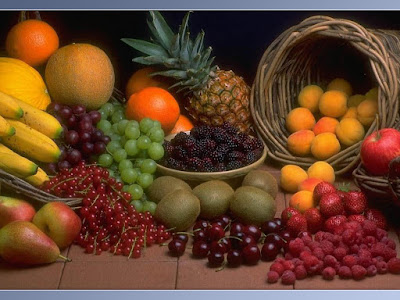

Olives
References to the olive are scattered throughout the Bible: The olive branch was a symbol of peace brought to Noah after the Great Flood, and olive oil was poured into the wounds of the man on the road by the Good Samaritan. Considered a fruit, olives were eaten whole as food and pressed to make oil for cooking and medicinal uses. Today we know more about the healing benefits of olives and olive oil: They contain monounsaturated fatty acids, which can lower cholesterol levels and reduce the risk of cardiovascular disease.

Honey
In the Bible honey is mentioned quite often. It is most frequently used to say how sweet something is. "And I took the little book out of the angel's hand, and ate it up; and it was in my mouth sweet as honey." (Rev. 10:10) John the Baptist depended on honey for his survival: "And John himself was clothed in camel's hair, with a leather belt around his waist; and his food was locusts and wild honey." (Mt. 3:4)."
Honey is a sweet fluid made by honeybees. The bees make honey to feed the baby bees (larvae). Also, they need honey in order to stay alive during the winter. It is stored in aged honeycombs by the bees.
There is no mention of beekeeping in the Bible, but wild honey was plentiful. It's a store house of natural energy. Honey contains boron, a vital mineral sadly lacking in the modern diet. It has tranquilizing powers, and can aid in healing wounds.

Apple
The Song of Solomon takes place within the setting of a garden. The person responsible for penning the Song of Solomon had an interest in plans and was accomplished in the science of plants (as told in I Kings 4: 33). Throughout the test, more than 20 different plants are mentioned, which is more than any other book in the Bible – with the exception of Isaiah.

In the Song of Solomon, the apple appears in the following places:

"Like an apple tree among the trees of the forest is my lover among the young men. I delight to sit in his shade, and his fruit is sweet to my taste." [New International Version; 2:3]

"Who is this coming up from the wilderness Leaning on her beloved?" "Beneath the apple tree I awakened you; There your mother was in labor with you, There she was in labor and gave you birth." [New American Standard Version; 8:5]

The apple is also mentioned in Joel 1:12 ("The vine is dried up and the fig tree is withered; the pomegranate, the palm and the apple tree--all the trees of the field--are dried up. Surely the joy of mankind is withered away" – New International Version) and Proverbs 25:11 ("Like apples of gold in settings of silver is a word spoken in right circumstances" – New American Standard Bible).

The apple and apple tree is a popular plant in many parts of the world. It is respected for its beauty, fragrance, and ability to produce an abundance of fruit.

Other references to the apple in the Bible include:

"Keep my commands and you will live; guard my teachings as the apple of your eye." [New International Version; Proverbs 7:2]

"For thus says the LORD of hosts, "After glory He has sent me against the nations which plunder you, for he who touches you, touches the apple of His eye." [New American Standard Bible; Zechariah 2:8]

Melon
When you think of the Bible, you probably did not envision melons being a part of the ancient diet. There is only one verse that mentions melons, and that is in Numbers 11: 5-6: "We remember the fish, which we did eat in Egypt freely; the cucumbers, and the melons, and the leeks, and the onions, and the garlick" [King James Version]. The melon in the reference may point to the common watermelon. In Biblical days, this melon was most likely much smaller than the fruit we see in today's North American crops.

Almond
The almond tree is a native of Syria and Palestine. Its blossoms are very pale pink and appear before its leaves. Its Hebrew name, shaked signifies “wakeful, hastening” because it blossoms so early, generally in February, and sometimes even in January. In Eccl. 12:5, it is referred to as illustrative, probably, of the haste with which old age comes. There are others, however, who contend for the old interpretation here. “The almond tree bears its blossoms in the midst of winter, on a naked, leafless stem, and these blossoms (reddish or flesh-coloured in the beginning) seem at the time of their fall exactly like white snow-flakes. In this way the almond blossom is a very fitting symbol of old age, with its silvery hair and its wintry, dry, barren, unfruitful condition.”

In Jer. 1:11 “I see a rod of an almond tree [shaked]… for I will hasten [shaked] my word to perform it” the word is used as an symbol of promptness. Jacobwanted his sons (Gen. 43:11) to take with them into Egypt of the best fruits of the land, almonds, etc., as a present to Joseph, probably because this tree was not a native of Egypt.
Aaron's rod yielded almonds (Num. 17:8; Hebrews 9:4).
Moses was directed to make certain parts of the candlestick for the ark of carved work “like unto almonds” (Ex. 25:33-34).
The Hebrew word luz, translated “hazel” in the King James Bible (Gen. 30:37), is translated as “almond” in the Revised Version, New King James Version, New International Version and the New Revised Standard Version. It is probable that luz means the wild almond, while shaked means the cultivated variety